hydroLOVEgy.
remembering with water
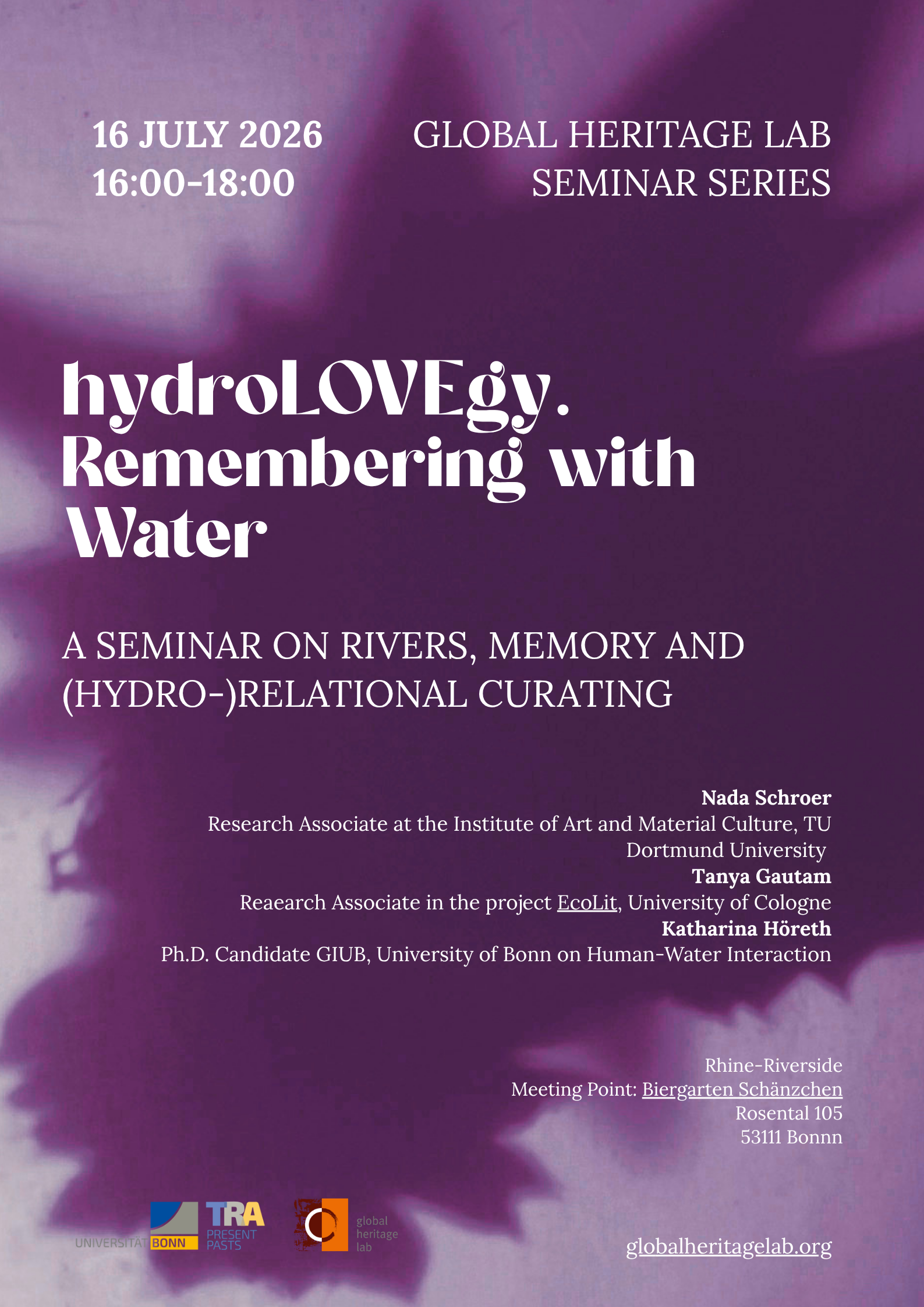
A seminar on rivers, memory and (hydro-)relational curating
Thursday, 16 July 2026, 16:00-18:00 CET
at Rhine Riveside
Meeting point: Biergarten Schänzchen, Rosental 105, 53111 Bonn
© Stephanie Beaugrand
hydroLOVEgy: remembering with water explores the river Rhine as living archives. Through embodied perception exercises, collective reflection, and a short scientific input from hydroecology/geography, the workshop invites participants to engage with the Rhine from various perspectives: as a geographical or hydrological river system, but also as a vital, affective entity and hydrosocial assemblage.
At the center of the gathering are questions such as: How does water remember? How do rivers archive and transmit traces of histories? How do they shape personal and collective memories? How do we remember ourselves as watery bodies that are inseparably connected to other water bodies? And how can we become attentive again to the shared hydrocommons that connect human and more-than-human life?
The aim of the workshop is to create a space in which participants can connect to the Rhine through different forms of storytelling and sensing. It brings together artistic-curatorial, bodily situated, and scientific modes of knowing in order to make different epistemological approaches to the river perceptible and discussable. Here, (hydro-)relational curating is understood as a polydisciplinamorous practice that creates a space of multimodal attention, inviting participants to encounter the river beyond purely functional or rational modes of engagement and to become part of a meshwork of hydrorelations.
Meeting point: Biergarten Schänzchen, Rosental 105, Bonn
When: 16:00 – 18:00 CET
No registration needed
Photography & Filming: This event will be photographed and filmed to document the interactive water experience. Participation is welcome regardless of whether you consent to being recorded. All participants are invited to complete a consent form, where they can indicate their preferences regarding photography, filming, and the use of any recordings.
hydroLOVEgy is a series of artistic-curatorial gatherings that invite polydisciplinamory into contemporary water research; hydroLOVEgy offers circular time travels into the hydrocene and arranges sensual dates between humans and other water bodies, such as rivers, aquifers, lakes, ponds, canals, or swimming pools; if needed, hydroLOVEgy also facilitates direct encounters with water ghosts; conceived by Nada Rosa Schroer with invited guests. The aim of the workshop is to create a space in which participants can connect to the Rhine through different forms of knowing and sensing. Here, (hydro-)relational curating is understood as a polydisciplinamorous practice that creates a space of multimodal attention, inviting participants to encounter the river beyond purely functional or rational modes of engagement and to become part of a meshwork of hydrorelations.
Nada Rosa Schroer is an independent curator based in Cologne and a research associate at the Institute of Art and Material Culture at TU Dortmund University. In her PhD research she brings together hydrofeminist storytelling and curatorial practice, with a focus on (post-)industrial water bodies and the development of curatorial research methods for rethinking human–water relations collectively.
is Research Associate at the Institute of Art and Material Culture, TU Dortmund University and Independent Curator.
She previously worked as a curator at the LWL Museum of Art and Culture and the LWL Industrial Museums, and collaborated with institutions including the Academy of the Arts of the World, the Rautenstrauch-Joest Museum, PACT Zollverein, and the International Photoszene Cologne. Since 2020 she has regularly collaborated with Temporary Gallery Cologne, where she co-curated several programmes and exhibitions, including Towards Permacultural Institutions (2022), Curating Transformation (2023), and All of the Critters (2024).
She has led several third-party funded research projects, including Curating Water Multiplicities (2025), and recently presented her work at conferences such as the AAA, DGSKA, DGEKW, POLLEN and EASA. She co-edited Towards Permacultural Institutions: Exercises in Collective Thinking (2023) and Curatorial Learning Spaces: Art, Education and Curatorial Practice (2023).
Tanya Gautam a.k.a Moonlit Brooks is a poet, cultural promoter and educator from Surat, India based in Cologne, Germany. She is currently pursuing her doctoral studies as part of the EcoLit research project funded by Germany’s Federal Ministry of Education. In her research, she explores informal and non-formal practices of cultural education, focusing in particular, on ways of cultivating multispecies community futures through music and literature based practices. She is the founder of Moonlit Brooks – a spoken word project under which she also curates multidisciplinary cultural events in Germany since February 2020. As a poet, Tanya explores the beauty and brutality in living, belonging and passing.
Katharina Höreth is a Ph.D. candidate at the GIUB, University of Bonn. In her research she focuses on Human-Water Interactions, natural water resources and management and makro litter in large river system.
This session of the Global Heritage Lab Seminar Series forms part of the research–exhibition project Knowing Plants: Ecologies of Memory and Practice.