
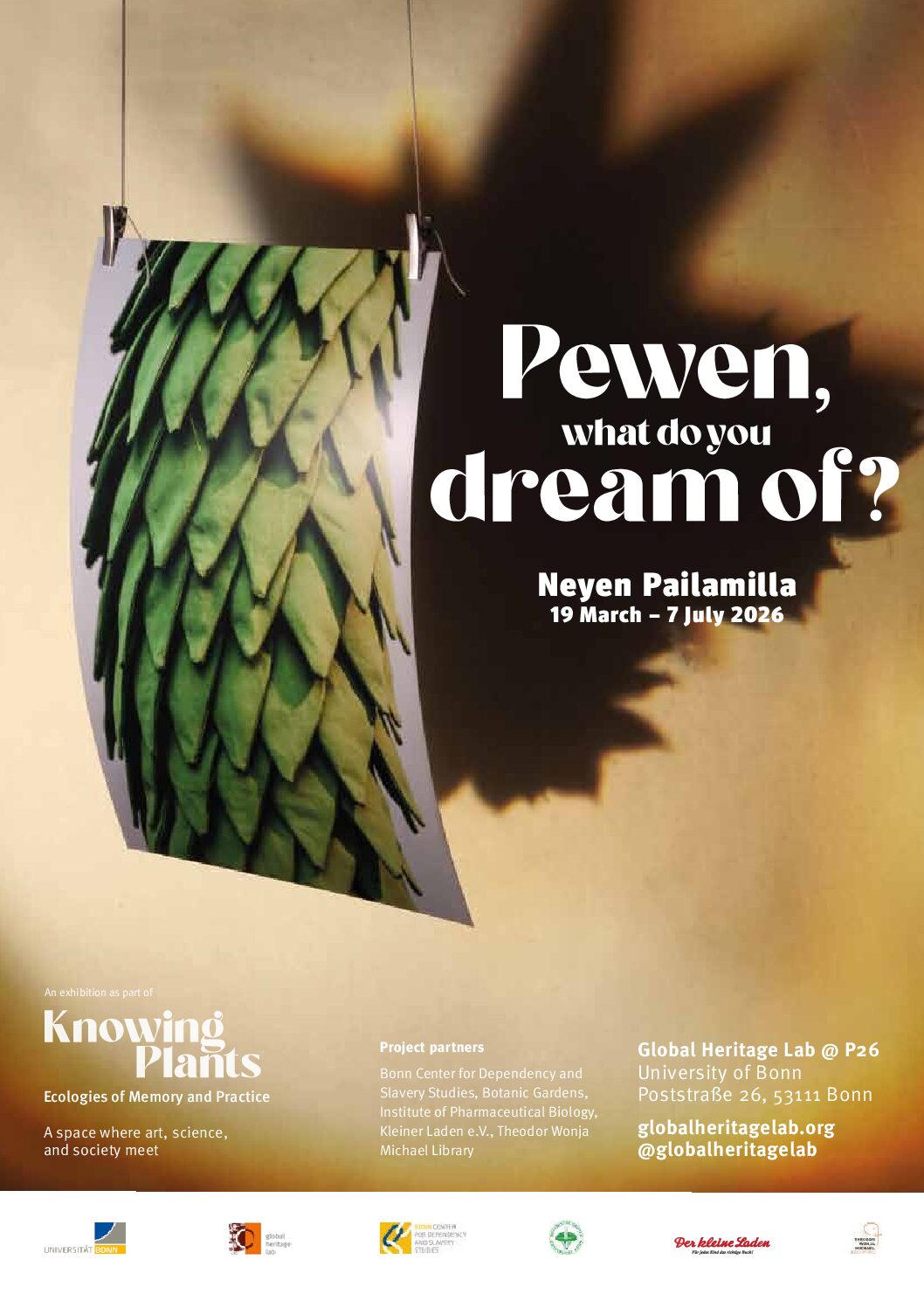
Exhibition Opening: Knowing Plants – Ecologies of Memory and Practice
19 March 2026
4:00 PM – Performance by Neyen Pailamilla in the Botanical Gardens of the University of Bonn
Meeting point: Café Nees, Meckenheimer Allee 169, 53115 Bonn
6:00 PM – Exhibition Opening at the Global Heritage Lab @ P26
Poststraße 26, 53111 Bonn
We warmly invite you to the opening of the exhibition Plant Knowledge – Ecologies of Remembering and Acting.
What forms of knowledge shape the ways we relate to plants and our environment – and how can we create sustainable relationships with them?
The exhibition invites visitors to engage with historically shaped relationships with plants, ecosystems, and waters, and to reflect together on more responsible ways of engaging with the environment.
Across the four seasons, artists with family connections to Chile, Australia and New Zealand, Nigeria, Mauritius, India, and Jamaica enter into dialogue with researchers from the University of Bonn and members of the city’s wider community. Together, they create a space for learning and encounter that explores questions of sustainability, memory, and transformation from transdisciplinary perspectives.
On 19 March, Neyen Pailamilla will open the exhibition cycle with their performance Transplant: Healing in the Mapuche Diaspora. The performance begins in the Botanical Gardens, highlighting the dialogue between natural and cultural sciences, art and society, and humans and the environment.
Neyen Pailamilla’s artistic work is also the focus of the first chapter, Spring: What Does Pewen Dream Of? Several participatory elements accompany the chapter. In the fragrance laboratory – developed in collaboration with the Institute of Pharmaceutical Biology – visitors can explore the scent of the sacred Mapuche tree, Pewen. Two reading areas, curated by the first Black library in North Rhine-Westphalia, the Theodor Wonja Michael Library, and by the children’s and young people’s bookshop Kleiner Laden e.V., invite visitors to linger, browse, and reflect.
The exhibition is supported by the Bonn Center for Dependency and Slavery Studies.
We look forward to welcoming you and to the conversations the exhibition will inspire.