The Consequences of Digitalising Collective Memory in China
Thursday, 19th February 2026, 4 – 6 pm
GHL, Poststr. 26, 1st Floor Seminar Room
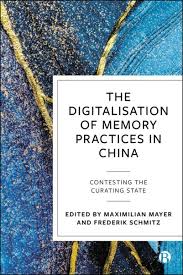
Image: © Bristol University Press
The GHL seminar series continues on Thursday, February 19th. We are pleased to welcome Vivien Markert, Frederik Schmitz and Dr. Maximilian Mayer to present and discuss their book “The Digitalisation of Memory Practices in China: Contesting the Curating State.” (2025).
Building on their pioneering volume, this session delves into how rapidly evolving digital technologies are reshaping the politics of memory in contemporary China. Building on the book’s concept of the “curating state,” the discussion examines how digitalisation empowers non-state actors to preserve alternative narratives and challenge official histories while simultaneously equipping the Party-state with new tools to reinforce and control memory discourses. The discussion reflects on this paradoxical terrain and examines technology, power, and memory curation in China’s evolving sociotechnical landscape, where the past is reimagined, contested and censored.
As a space for experimentation and dialogue, the series seeks to critically explore multiple pasts and presents to envision alternative futures. It aims to bring scholars and practitioners from across the globe together to engage, interact and address the current global multi-faceted crisis involving economic, ecological, social and cultural challenges and negotiations of heritage and museums as powerfully charged, conflictual, and creative spaces.
Presenter
Vivien Markert is a Research Fellow and PhD candidate at the Department of Chinese Studies, University of Tübingen. She is doing research on religion politics in China with special focus on Islam.
Frederik Schmitz is a Research Fellow and PhD candidate at the University of Bonn. He is doing research on legitimacy and the use of history in China.
Dr. Maximilian Mayer is a Junior Professor of International Relations and Global Politics of Technology at the University of Bonn. His research interests include the global politics of science, innovation, and technology; China’s foreign and energy policy; global energy and climate politics; theories of International Relations.
Discussant
Dr. Sandra Gilgan leads the Bonn Research Alliance (BORA) of the University of Bonn. As a cultural scientist with expertise on China, Her interests include Confucianism, ‘utopian thinking’, ‘utopia as method’, and ‘plural sustainabilities’.
Join us at the Global Heritage Lab at P26 or online
© Volker Lannert