

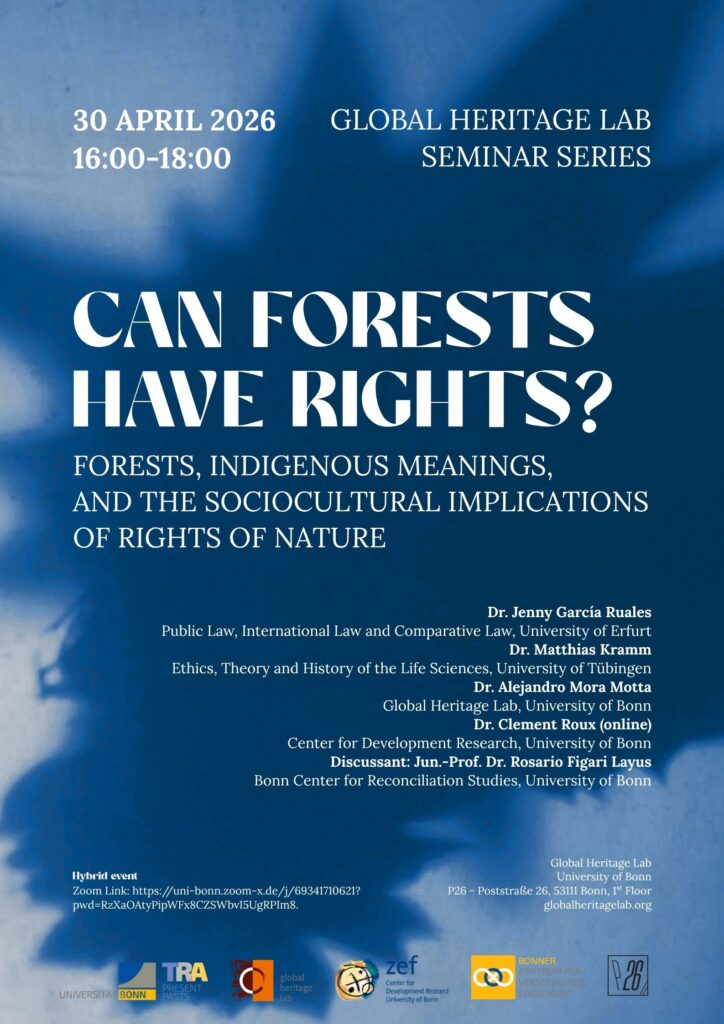
Can forests have rights? Forests, indigenous meanings, and the sociocultural implications of the “rights of nature”
Thursday, 30 April 2026, 16:00-18:00
GHL, Poststr. 26, Bonn, 1st Floor Seminar Room
© Stephanie Beaugrand
The GHL seminar series continues on Thursday, April 30th with a Panel Discussion bringing together Matthias Kramm, Jenny García Ruales, Alejandro Mora Motta, Clément Roux and Rosario Figari Layús for a conversation on: Can forests have rights? Forests, indigenous meanings, and the sociocultural implications of the “rights of nature”.
The idea of the ‘rights of nature’ brings together notions of how humans and nature interrelate and of how to operationalise these relations within institutions and state structures. This Panel Discussion engages provocative sociopolitical and cultural elements, including what happens when forests are granted rights, ranging from posthuman Constitutionalism, legal personhood, indigenous rights and law, activism and engaged research, and environmental peace. The discussion will focus on cases in Latin America and their potential application in Germany.
Presenters:
Matthias Kramm is Akademischer Rat auf Zeit at the University of Tübingen, and he began a Marie Curie Postdoctoral Fellowship at the University of Kassel in April 2026. He specializes in political philosophy, non-Western philosophy, and environmental ethics.
Jenny García Ruales is a Research Associate at the Chair of Public Law, International Law and Comparative Law within the Amazon of Rights project at the University of Erfurt. She focuses on Environmental Anthropology, Anthropology of Nature, and Legal Anthropology. Her research contributes to ecocentric legal systems in the (Ecuadorian) Amazon, recognizing the rights of natural entities.
Alejandro Mora Motta is a Postdoctoral Researcher at the Global Heritage Lab, University of Bonn. His research interests cover transdisciplinary fields such as political ecology, ecological economics and critical heritage and development studies. Focusing on Chile and Colombia, he explores how local communities draw upon traditional knowledge to resist processes of resource extractivism.
Clément Roux is a senior researcher in the Cultural and Political Change (CPC) Group at ZEF. He works on the concept of ‘environmental peace’ in contexts marked by armed conflict and ecological transformation. His research combines cultural studies, communication analysis and participatory fieldwork in Colombia to explore how imaginaries, knowledge practices and media shape pathways towards peaceful coexistence between humans and nature.
Discussant:
Rosario Figari Layús is Junior Professor and Spokesperson of the Center for Reconciliation Studies, University of Bonn. Her research focuses on reconciliation, human rights, transitional justice, the protection of human rights defenders, victims’ rights, political and state violence, and national and international criminal proceedings relating to human rights violations. She was awarded the Voltaire Prize for Tolerance, International Understanding and Respect for Differences in 2025.
Join us at the Global Heritage Lab at P26 or online
Link: https://uni-bonn.zoom-x.de/j/69341710621?pwd=RzXaOAtyPipWFx8CZSWbvI5UgRPIm8.1
This project is possible thanks to the Arglander Academy Grants of the Argelander Program of the University of Bonn.