
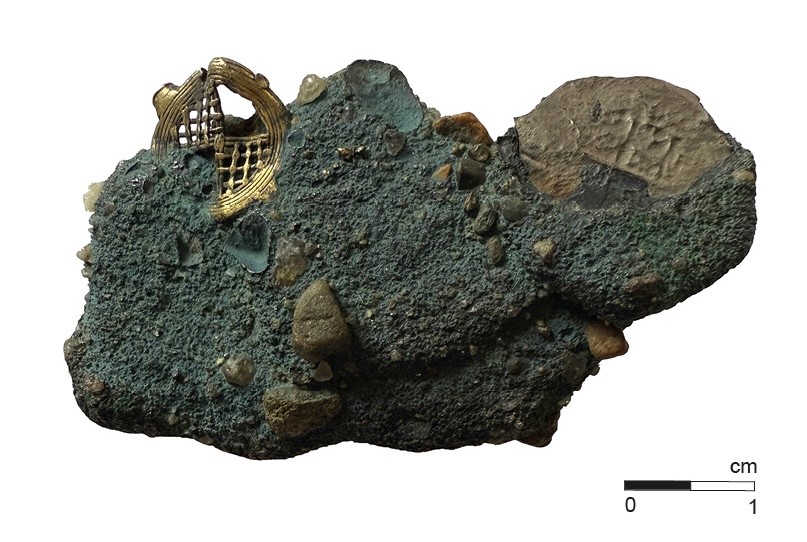
We are pleased to share that our fellow Dr. Tobias Skowronek has published a new article titled “Pirate Gold Provides New Insights into West African Trade Using pXRF and SEM-EDS Analysis.” The study offers fascinating new perspectives on historical trade networks in West Africa, combining innovative analytical techniques with interdisciplinary research.
Paper abstract
Goldwork is central to Akan cultural heritage and was a key commodity in European trade along the West African coast for centuries. Previous assessments of gold quality have relied mainly on speculative, biased and largely unquantified European written sources. Here, we present elemental composition data of Akan gold artifacts recovered from the wreck of the pirate shipwreck the Whydah Gally (1717), obtained using portable X-ray fluorescence (pXRF) and Scanning Electron Microscopy (SEM-EDS). The results are compared with contemporary written accounts and published compositional data from gold deposits in Ghana’s Ashanti Gold Belt. The observed elemental patterns do not support claims of systematic heavy adulteration of Akan gold; instead, most compositions fall within the natural variability of West African gold. However, due to variability in the ore data the applied methods cannot conclusively identify intentional additions of silver or copper, highlighting the need for fully quantitative analytical approaches.
Reference:
Skowronek, T.B., Clifford, B. & DeCorse, C.R. Pirate gold provides new insights into West African trade using pXRF and SEM EDS analysis. npj Herit. Sci.14, 169 (2026). https://doi.org/10.1038/s40494-026-02441-7